Minister Multala: Preserving biodiversity supports Europe’s competitiveness and stability of societies - Finland at forefront in developing new funding solutions
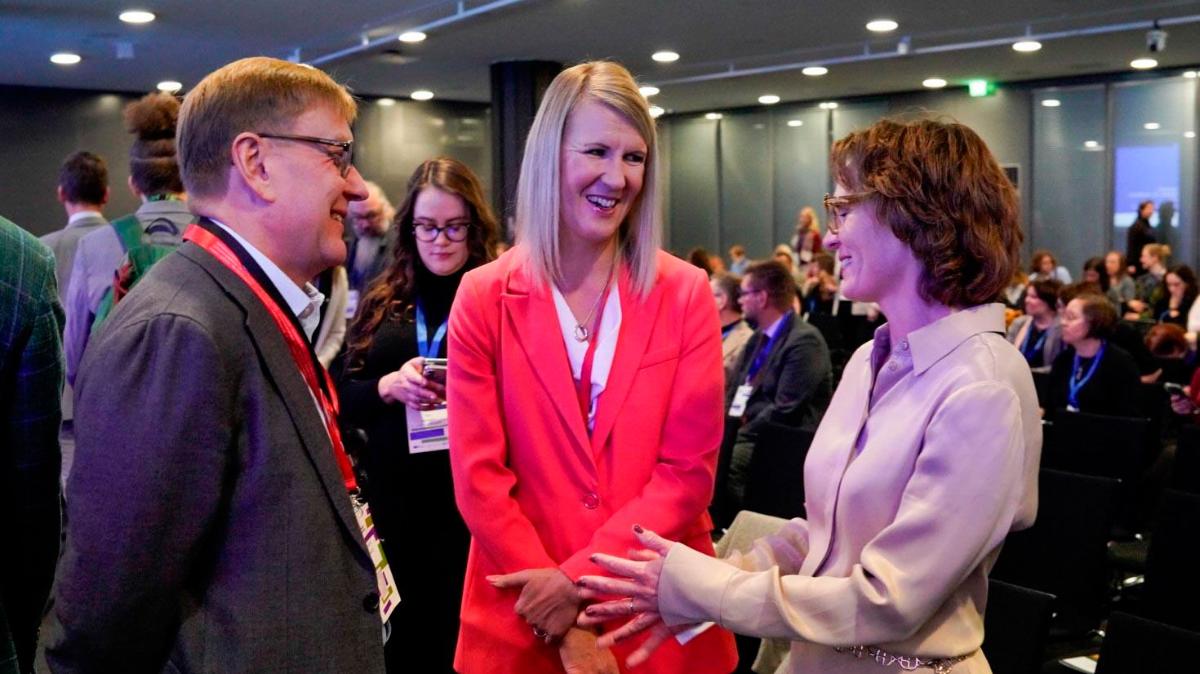
Finland’s circular economy solutions and active role in developing nature funding for companies were strongly highlighted at the European Business & Nature Summit 2025 in Helsinki. In connection with the event, Minister Multala met Environment Commissioner Jessika Roswall and Eric Mamer, Director-General of the European Commission’s Directorate-General for Environment.
The international summit organised by the European Commission and Finnish Innovation Fund Sitra brought together leaders from businesses and the financial sector and political decision-makers in Helsinki on 23–24 October.
In her speech in the opening panel of the event, Minister of Climate and the Environment Sari Multala stressed Finland’s role as a developer of circular economy solutions and enabler of nature actions taken by companies. Taking care of natural capital is an important part of comprehensive security. It also offers new business opportunities for companies.
“Taking care of biodiversity is a key condition for Europe’s competitiveness, resilience and stability in the long term. Companies are showing the way in this – through their actions they can accelerate the change needed by the whole society while also strengthening their own, sustainable business activities,” Multala said.
Voluntary ecological compensation under the Nature Conservation Act makes it possible for companies to offset harmful impacts on nature. Ecosystem services markets are based on the idea that ecosystem services produced by nature have a financial value which the markets can identify and set a price on. Finland is among the world leaders in the application of ecological compensation and development of ecosystem services markets. At the moment, Finnish solutions are attracting wide interest in the EU.
“The circular economy and bioeconomy solutions we are developing address the root causes of biodiversity loss. Promising results have been reached in sectors such as the construction industry, where there is a lot of potential to influence the positive ‘nature handprint’. Through a circular economy we become less dependent on critical raw materials, strengthen the resilience of society and promote security,” Multala says.
The minister stressed cooperation between different sectors as a way to accelerate the solutions. As an example she mentioned the Circular Economy Green Deal, through which companies and other actors can make a commitment to reduce the use of natural resources and improve resource efficiency. When it comes to the bioeconomy, Finland is developing solutions such as plant-based materials, biochemicals and food systems where a circular economy has a key role.
However, the positive actions taken by companies need strong support and directions from legislation. Multala referred to the EU’s upcoming Circular Economy Act as an important initiative to promote innovation and reduce the use of resources as we aim for a competitive and stable EU.
In connection with the event Minister Multala met Jessika Roswall, Commissioner for Environment, Water Resilience and a Competitive Circular Economy, and Eric Mamer, Director-General of the European Commission’s Directorate-General for Environment.
“We are engaged in active dialogue with the European Commission with the aim to simplify the regulation so that it is clear and predictable for businesses. We are among the leaders in developing legislation that supports ecosystem services markets and a circular economy. Our aim is to bring the good practices and solutions produced in Finland into wider use in the EU,” Multala says.
Inquiries:
Lyydia Ylönen
Special Adviser to Minister Multala
tel. +358 50 476 1341
[email protected]
Emma Terämä
Director, Biodiversity and Nature Value Finance
tel. +358 295 250 255
[email protected]
Ministry of the Environment