
IPBES: Businesses can become agents of nature-positive change – assessment report approved after successful negotiations
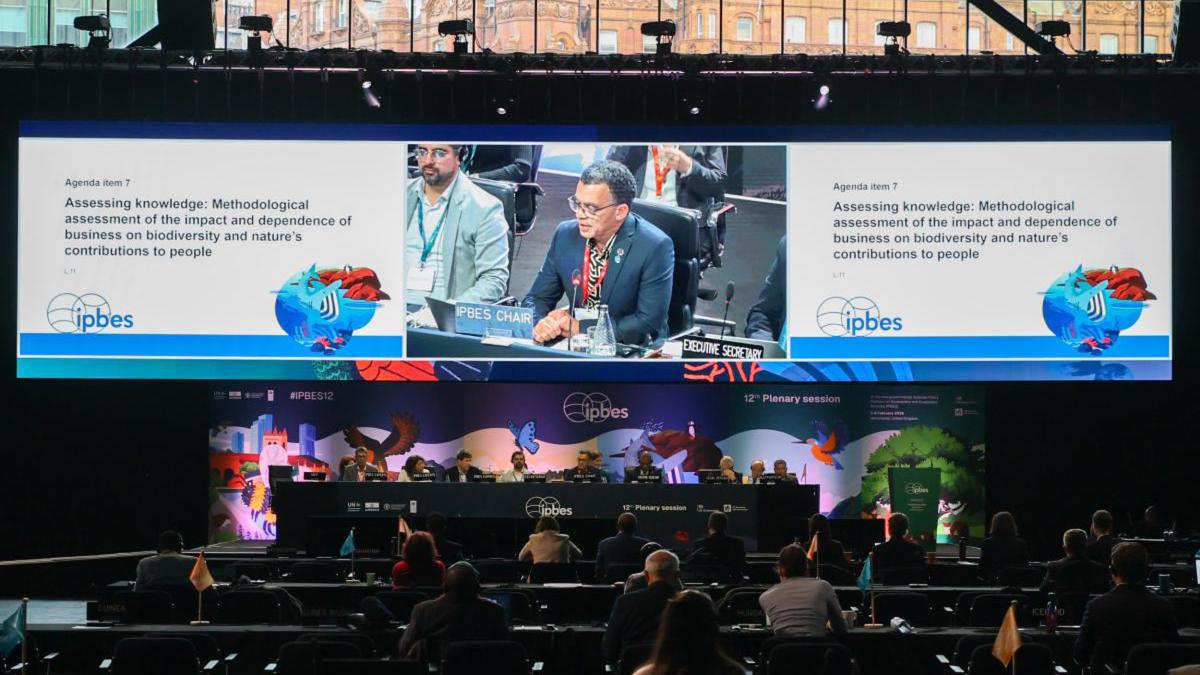
The latest assessment report from the Intergovernmental Science‑Policy Platform on Biodiversity and Ecosystem Services (IPBES) underlines the responsibility of businesses for their impacts on nature. The current business conditions do not support halting biodiversity loss. Broad structural changes are needed and can be driven by governments. However, businesses already have the knowledge and opportunities to act in ways that are sustainable for nature. The report also highlights confidence in the potential of businesses to become agents of nature-positive change.
IPBES convened for its 12th Plenary in Manchester, United Kingdom, from 3 to 8 February, and approved the Business and Biodiversity Assessment. It examines how businesses affect and depend on biodiversity and brings together metrics, methods and approaches that businesses can use to assess their impacts and support global biodiversity goals.
Global win for science and collaboration – IPBES delivers a constructive negotiation
IPBES is an independent intergovernmental body under the auspices of the UN, similar to IPCC. It approved the report in a celebratory atmosphere after successful negotiations.
“Collaborative action and evidence‑based decision‑making are under pressure from many directions, and geopolitical uncertainty is also reflected in environmental negotiations. Yet this IPBES Plenary succeeded in providing constructive dialogue. Working with member states and the report’s authors, we achieved a much-anticipated Summary for Policymakers that everyone supports. Member states now have strong collective ownership of the report they have finalised together – it is a global win for science and collaboration,” says IPBES Bureau member Eeva Primmer, Research Director, the Finnish Environment Institute, and one of the chairs guiding the discussions on the assessment report.
Incentives for nature‑sustainable business remain inadequate – Finland among the frontrunners in developing solutions
According to the report, businesses are responsible for their impacts on nature across the entire value chain, from raw‑material sourcing to product use and end‑of‑life stages. IPBES stresses that reducing negative impacts and enhancing positive impacts on nature form part of companies’ due diligence.
The report notes that incentives for business models that are sustainable for nature and the structures enabling them remain insufficient, even though many positive examples exist. Importantly, gaps in knowledge or incomplete rules should not be used as an excuse for inaction. Businesses can take immediate, concrete steps both within their own operations and across value chains.
“Many Finnish businesses are already keen to advance action for nature. When they choose to, businesses can be more agile than governments in driving the sustainability transition. The central government’s role is to ensure that the business environment supports this work. Finland is at the forefront internationally, for example in developing nature value markets and other solutions that make nature-positive business easier,” says Suvi Borgström, Senior Specialist at the Ministry of the Environment and Finland’s National Focal Point to IPBES.
Report emphasises collaboration and inclusion
Transformative change will not happen without broad collaboration. Governments, financial institutions, businesses, civil society, and Indigenous Peoples and local communities all play crucial roles in enabling change.
The report also calls attention to challenges in prevailing economic thinking. A narrow focus on GDP has been a major factor accelerating biodiversity loss and may hinder the building a nature‑positive business environment. According to IPBES, new metrics and policy tools that recognise the value of nature and human wellbeing are needed.
Finally, the assessment underscores the importance of existing knowledge. Although development needs remain, current methods and data are sufficient to guide decisions and action towards an ecologically sustainable future.
Intergovernmental Science-Policy Platform on Biodiversity and Ecosystem Services (IPBES)
IPBES produces comprehensive scientific assessments of the state of biodiversity, changes in it and its impacts on human wellbeing. The task of IPBES is to strengthen the science-policy interface for questions related to biodiversity and ecosystem services. IPBES supports and promotes the implementation of international biodiversity and climate agreements. It serves the international community, governments and societies.
On the report publication date at 15.00, the Finnish Nature Panel published a memorandum that explores the key messages of the IPBES report from the Finnish perspective. The Ministry of the Environment, Finnish Environment Institute, Finnish Nature Panel and IPBES Working Group will organise a stakeholder event on the topic on 10 March 2026.
Inquiries:
Eeva Primmer, Research Director, IPBES Bureau member, Finnish Environment Institute
tel. +358 29 525 1521
[email protected]
Suvi Borgström, Senior Specialist, IPBES National Focal Point, Ministry of the Environment
tel. +358 295 250 342
[email protected]
Johanna Niemivuo-Lahti, Senior Ministerial Adviser, Ministry of Agriculture and Forestry
tel. +358 295 162 259
[email protected]