
Finnish Biodiversity Award to Crowdsorsa mobile game to fight against invasive alien species
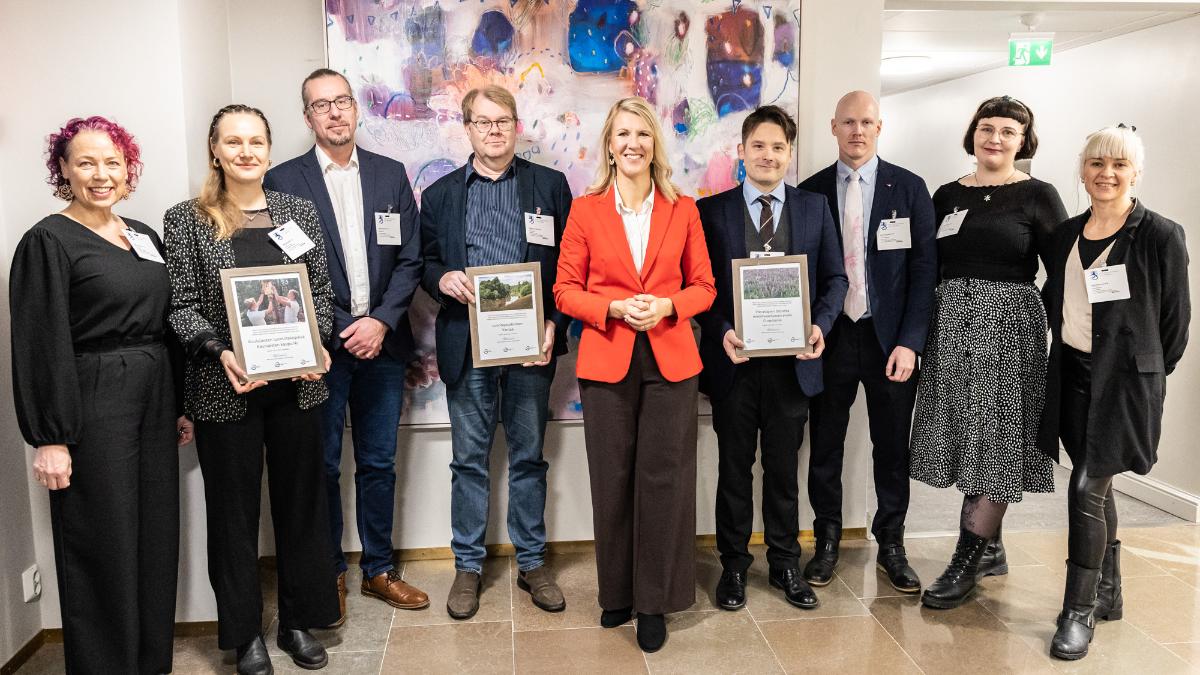
Finnish Biodiversity Award 2023–2024 was given to an actor that had done something inspiring to halt biodiversity loss. The winner of the competition was Crowdsorsa mobile game that has already helped fight against invasive alien species in Finland on a total of 4 million square metres. Honourable mentions were awarded to the cities of Kauniainen and Vantaa. The prizes were awarded by Minister of Climate and the Environment Sari Multala.
The competition is organised by the National Committee of Finland of the International Union for Conservation of Nature IUCN. This year the focus was on actions that have inspired to wider action and cooperation to preserve or improve the state of the natural environment. The jury was particularly interested in actions that inspire especially young people to participate in the efforts to halt biodiversity loss.
The mobile application to fight against invasive alien species is a game developed by the start-up Crowdsorsa, with almost 200,00 registered users already. It makes it easy for people to participate in the work to fight against invasive alien species in urban areas and other actions and surveys to improve the environment.
In the game the participants record deposits of invasive alien species on video before and after the work to prevent them. Approved actions are rewarded. The species fought against include Himalayan balsam, lupine, rugosa rose and Canadian goldenrod.
“It is truly great how Finnish game industry can help us in innovative work for nature and inspire young people to participate! Gamification offers the municipalities and cities a cost-effective and easy way to involve residents in the fight against invasive alien species and work for nature in their own neighbourhoods. This is the kind of Finnish expertise we are proud to take to the world,” Minister of Climate and the Environment Sari Multala says.
In Finland the mobile game is already in use in 65 municipalities and in Åland. It is also spreading internationally and is being used in Sweden and Canada as well. Last summer work to fight against invasive alien species covered more than 3 million square metres and more than 600 litres of Spanish slugs were collected in Finland, Sweden and Canada. A total of EUR 170,000 was handed out to the participants as rewards for good work done for the environment.
“I wish to warmly thank the municipalities and especially the players who have made these great achievements possible. Work repeated on an annual basis is truly producing good results. Even deposits that we have not yet managed to eradicate completely have clearly declined, which makes it more cost-effective to prevent them in the following year. In 2026 we will focus on estimating the long-term costs of combating invasive alien species so that the municipalities can understand better how much it will cost to completely solve the problem,” CEO Toni Paju from Crowdsorsa says.
The project is funded by the municipalities’ commitments to fight against invasive alien species in their areas. The company reports the data on the observations and the work done to the national alien species portal at vieraslajit.fi.
Honourable mentions: Kauniainen and Vantaa
Diplomas for a deed for the benefit of Finnish nature in 2023–2024 were awarded to the cities of Vantaa and Kauniainen. The honourable mentions were awarded for particularly valuable and inspiring work for nature.
Kauniainen has developed an ambitious GreenGrani sustainability education model to which all schools in the municipality participate. The model is based on the GreenComp reference framework for sustainability competences. One of the key elements of the model is a day dedicated to nature deeds when all schoolchildren take some kind of action for nature at the same time. The city provides the materials and tools needed for this, which ensures extensive opportunities to participate.
Vantaa is a trailblazer in promoting biodiversity, promoting nature positivity and making use of ecological compensation. The aim for the city is that, by 2030, biodiversity will grow and harm to nature will be compensated for in cooperation with the businesses and residents. Finland was the first city in Finland to start using the ecological compensation under the Nature Conservation Act: for all new local detailed plans where harm to nature is caused compensation is required as a legally binding element of the zoning process.
Finnish Biodiversity Award and IUCN
This was the tenth competition organised by the National Committee of Finland of the International Union for Conservation of Nature IUCN. The aim is to find ingenious solutions and innovations that support the efforts to halt biodiversity loss.
The previous Biodiversity Awards have gone to:
• 2022: Restoration of the River Hiitolanjoki ecosystem as a breeding area for Ladoga salmon and for recreation. This was achieved through extensive and long-term cooperation.
• 2020: Save the Buzzers campaign of YLE. The campaign raised awareness of the severity of pollinator loss among the wider public.
• 2018: Juha Salonen and active brook restoration volunteers worked to restore the urban brook of Longinoja in the Malmi suburb of Helsinki as a diverse stream and to safeguard spawning areas for sea trout.
• 2016: Actions by Wolf Ambassadors of the Finnish Nature League to dispel the fear of wolves through science-based information targeted to children and young people.
• 2014: Piling of artificial snow mounds by which hundreds of volunteers safeguarded the nesting of Saimaa ringed seal in a winter when there was little snow.
• 2012: Active approach of three journalists Peter Buchert (Hufvudstadsbladet), Päivi Mäki-Petäjä (MTV3) and Ann-Mari Rannikko (Turun Sanomat) in communicating about biodiversity.
• 2010: The way how the Finnish Natural Heritage Foundation purchases old-growth forests and ensures their permanent protection under the Nature Conservation Act.
• 2008: Decision by Espoo City Executive to protect an area of 550 hectares to honour the city’s 550th anniversary.
• 2006: Craft workshop of the Public Works Department of the City of Helsinki that landscaped the Vuosaari landfill in a way that was creative and favoured domestic species.
The International Union for the Conservation of Nature (IUCN) is the oldest and largest environmental organisation and network in the world. Its Finnish member organisations include the Finnish Government (represented by the Ministry of the Environment), the Finnish Association of Nature Conservation, WWF Finland, the Finnish Society for Nature and Environment (Natur och Miljö), BirdLife Finland, the Finnish Wildlife Agency and the Helsinki Zoo. The Ministry for Foreign Affairs, the Ministry of Agriculture and Forestry, the Finnish Environment Institute and Metsähallitus Parks & Wildlife Finland also participate in the work. In addition, a total of some 70 Finns voluntary experts and researchers participate in the work of the six IUCN Commissions.
Inquiries:
Matti Nummelin
Chair of the IUCN National Committee of Finland
tel. +358 400 802 556
[email protected]
Marina von Weissenberg
Vice-Chair of the IUCN National Committee of Finland, Senior Ministerial Adviser
Ministry of the Environment
tel. +358 50 307 0806
[email protected]